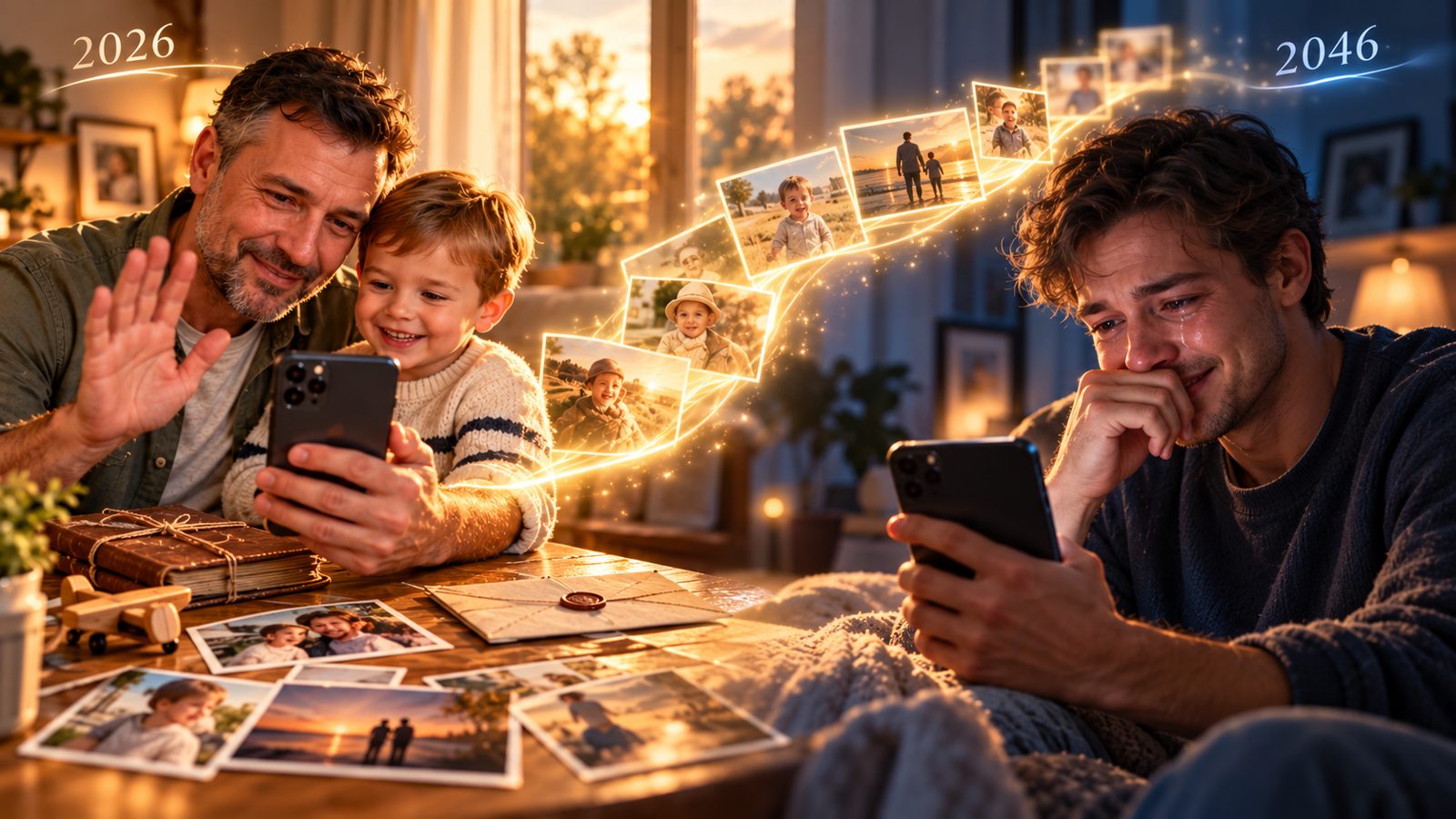
The scene below is fiction — an imagined story. The names and events are invented, but the feelings in it are entirely real.
2046. A morning he didn't expect
He wakes a little before the alarm. Grey October light at the window, the flat quiet except for the coffee machine muttering in the kitchen. Today he turns twenty. He pours coffee into his favourite chipped mug, sits by the window and opens his phone.
The birthday wishes arrive one after another: friends from university, a cousin in another city, a few silly animated cards. He smiles, keeps scrolling — and then stops.
"A message from your father has been saved for you. Recorded on 30 October 2026."
His thumb hovers over the screen for a second. Then he taps "Open".
A room appears that he barely remembers: an old lamp, flowered curtains, a shelf of framed photos. And his father — younger than he is now, with the first grey at his temples. In his arms is a two-year-old boy in a striped jumper, reaching for the camera.
"Hi, son. Today you're only two. You love toy cars, you're learning to talk, and every day you surprise us with something new. I don't know who you'll be in twenty years, where you'll live or what you'll dream about. But I want you to know: I loved you even back when you couldn't understand these words…"
The little boy on the screen laughs and tries to grab the phone. His father laughs with him. The young man by the window watches his tiny self, listens to that familiar voice — and for a moment the twenty years simply disappear. His coffee goes cold. He doesn't notice.
This story hasn't happened yet. But everything needed for it to happen already exists today: a phone, a few minutes, and the wish to say something to a person who hasn't yet become themselves.
How humanity learned to write to the future
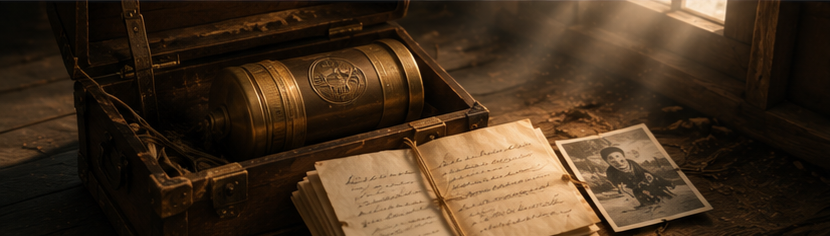
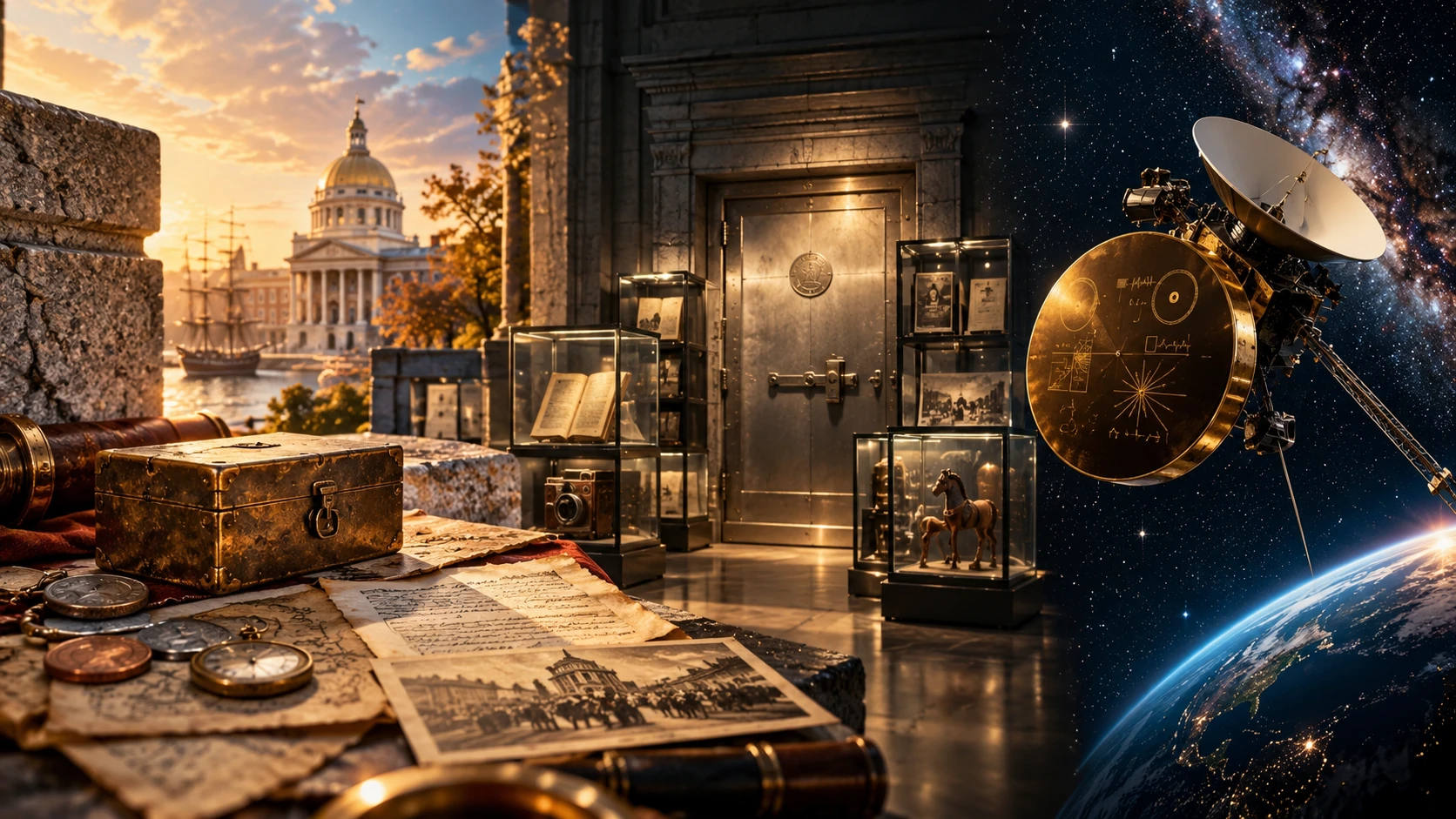
The urge to speak to those who come after us is one of the oldest we have. People carved names into stone, sealed notes into the foundations of houses, hid letters in chests and between the pages of family Bibles. Every such message is a small bet that the future will arrive — and that someone in it will want to hear us.
Only the tools have changed: paper, magnetic tape, email, video in our pockets. Let's look at them one by one — at what each can do, and what it can't.
Chapter 1. Paper letters that wait for decades
Picture a grandmother at the kitchen table with a pen and a sheet of paper. Her granddaughter has just turned three. She writes slowly, pausing often. She describes the first time the little girl said "Gran", the tomatoes they planted together, the song she sang at bedtime. At the end she writes: "I may not see you grown up. But I am already proud of you."
She folds the sheet, slips it into an envelope and carefully writes on the front: "To be opened on your eighteenth birthday."
A letter like this can wait in different ways. It can go into the family archive — the box of documents, photo albums and certificates. It can be entrusted to someone: a daughter, a son, an old friend. Sometimes it passes from hand to hand, generation to generation, and everyone who holds it becomes part of a small relay race.
A paper letter has advantages nothing else can match. Handwriting is almost a voice: the pressure of the pen, the uneven lines, the crossed-out word. Paper needs no passwords, no updates, no battery. You can touch it, smell it, keep it under your pillow.
But there is danger, too. Paper fears water, fire, damp and time. A box gets thrown out during a house move, an envelope goes missing, and the person it was entrusted to may simply forget where it is. The greatest threat to a paper message isn't fire — it's ordinary human forgetting.
Chapter 2. An email with scheduled delivery
Let's jump to 2026. Someone sits down one evening at their laptop and decides to write to themselves — for their birthday ten years from now:
"Hi, it's you from 2026. Right now I'm tired, a bit lost, and desperate to change jobs. Tell me honestly: did you do it? Do you still play the guitar? Do you call Mum more often than I do? If not — call her today."
The simplest way to delay a letter like this is scheduled sending. In Gmail it's called Schedule send: you write the email, click the arrow next to "Send", pick a date and time, and the message waits in a separate "Scheduled" folder. Google explains how it works in its own help page on scheduling emails.
It's important to understand the limits of this tool, though. Scheduled sending is designed for near-term convenience — so a message lands in the morning instead of at 2 a.m. Google's help page caps how many emails you can schedule and makes no promise about delivery decades ahead. Over fifty years, both inboxes — yours and the recipient's — may disappear, change or become inaccessible. Scheduled send is a lovely way to write to yourself next year, but not a reliable vault for a message meant to last half a century.
Chapter 3. FutureMe — a letter to your future self
Some services exist specifically for letters to the future. One of the best known is FutureMe: you write a letter, choose a date, and the service emails it to you when the time comes.
Another fictional scene. She's eighteen. She sits on the windowsill of her student halls, knees pulled up, writing to herself at thirty. She writes that she's scared of failing her exams. That she dreams of living by the sea. That she's in love with a boy who doesn't seem to notice her. That one day she wants her own little bookshop. At the end she adds: "Please don't become someone who forgot what she wanted."
Twelve years pass. On an ordinary Tuesday the letter arrives. She reads it on her lunch break in a café near the office. There's no sea nearby, and no bookshop. She barely remembers the boy from halls. But something else happens: she laughs at fears that now look so small, and she cries over a dream she put on hold. That evening, for the first time in years, she opens a document titled "Bookshop ideas".
Why is this so powerful? Because a letter like that is a conversation with the person we know best and forget fastest: our former self. It reminds us who we were, and lets us look honestly at the road we've travelled.
Chapter 4. Voice and video that carry us back
Now imagine an ordinary family dinner in 2026. Someone props a phone on a shelf and starts recording — just because, "for memory's sake". The table is noisy: Grandad tells the same fishing story for the third time, Mum laughs so hard she has to wipe her eyes, the youngest grandchild knocks over his juice and pretends nothing happened.
Thirty years go by. In 2056 the same family — different now, older, with new faces at the table — watches the recording. Grandad is gone. But there he is: waving his hands, winking, stumbling over the very same line. And everyone at the table laughs again.
Text tells us what happened. Voice and video show how it was. Intonation, the pause before a joke, laughter, the habit of touching one's chin — these are things words can't carry, and they are the first to fade from memory. That's why voice and video recordings so often become a family's most treasured possessions.
But a digital treasure needs looking after. Files can become corrupted, storage can fail, and formats go out of date. The Library of Congress has worked on digital preservation for years and stresses things that are obvious yet often forgotten: keep several copies in different places, check regularly that the files still open, and migrate them to current formats in good time. Digital memory lives only as long as someone takes care of it.
Chapter 5. Digital time capsules and AEEVOX
A modern digital time capsule brings together the best of everything above: the warmth of a letter, the life of voice and video, the convenience of scheduled delivery. That is what AEEVOX was built for — a digital home for family memory.
In AEEVOX you can keep what is usually scattered across phones, clouds and cardboard boxes:
- video messages — like those minutes with a father and his two-year-old son;
- voice messages — a lullaby, a greeting, a laugh;
- photos — together with the stories of who is in them and why that day mattered;
- personal letters — from a few lines to a long confession;
- family documents — so they don't get lost in a move;
- family stories — tales that used to be passed on only by word of mouth;
- links between generations — a family tree where every memory has its place.
Most importantly, a capsule can be prepared for a specific occasion: a future birthday, a wedding, an anniversary, a coming of age, or any other date that matters to your family. You choose the recipient and the day, and the message waits for its moment. We covered how to write such a message in detail in How to write your first time capsule letter.
Chapter 6. What if they've moved and changed their name?
This may be the most important question for any message to the future. Not "will the file survive?" but "will it find its person?"
Imagine thirty years have passed. The woman you wrote to has moved to another country, married and changed her surname. Her phone number is different; the email address you entered stopped working long ago. How will the message find her?
The honest answer: no system in the world can offer an absolute guarantee of delivery decades from now. But you can greatly improve the odds by combining several approaches.
1. Keep contact details up to date. The simplest and most reliable step. A capsule's recipient email and phone number can be edited, so it's worth reviewing your capsules from time to time — say once a year, on the day you created them.
2. Trusted relatives and authorised people. In AEEVOX you can name trusted people — legacy guardians who receive access to your archive according to the permissions you grant. Someone who knows the family can often find a recipient where no database would help.
3. Automated help reconnecting. Today AEEVOX sends messages to the email and phone number you provide and records the delivery status. Smarter help — where, with proper permissions, the system assists in reconnecting with someone whose contact details have changed — is a concept for the future, not a feature available now. And any such help would only be possible with respect for privacy and consent.
4. Physical delivery of a letter or storage medium. A paper letter, a USB stick or an album can be handed on through a solicitor, a relative or another person — but that is arranged separately, outside the digital platform.
5. Combine digital and physical channels. The most reliable plan is never to rely on just one thing. A digital capsule in AEEVOX, a paper envelope in the family archive, and a trusted person who knows about both — together they stand a far better chance of crossing thirty years than any of them alone.
Chapter 7. Messages aren't only for loss
It often seems that letters to the future are something sad, tied to saying goodbye. In truth, most of them are about joy.
- A couple records a video to open on their thirtieth wedding anniversary: how they met, what they promised each other, what they fear and what they hope for.
- A mother writes a letter for her daughter's future wedding — about her first steps, and about how love most often lives in the small things.
- A father records ten messages for his son's future birthdays — one for every year from eleven to twenty.
- A grandmother leaves her grandchildren stories of her childhood: the village school, her first bicycle, how the house smelled before the holidays.
- Someone prepares a message to themselves for their fiftieth birthday — full of questions they hope to have answered. For another example of a message finding its people across decades, read our story The capsule that arrived fifty years late.
Delivery through time isn't only about sorrow and loss. It's about love, family happiness, and carrying on a conversation that shouldn't end just because the years have passed.
Finale
We can't see the future. But we can leave a piece of ourselves in it.
Sometimes one minute of recording is enough. One letter. One sentence.
So that in twenty or fifty years someone will hear:
"Hi. I don't know what your world has become. But I want you to remember: in my world, you were one of the greatest gifts."
AEEVOX — memories that outlast time.
If there's something you want to say to someone in the future, start today. Create your first time capsule in AEEVOX: record a few words, choose a date — and let the message wait for its day.
Sources: Gmail Help — Schedule emails · FutureMe · Library of Congress — Digital Preservation