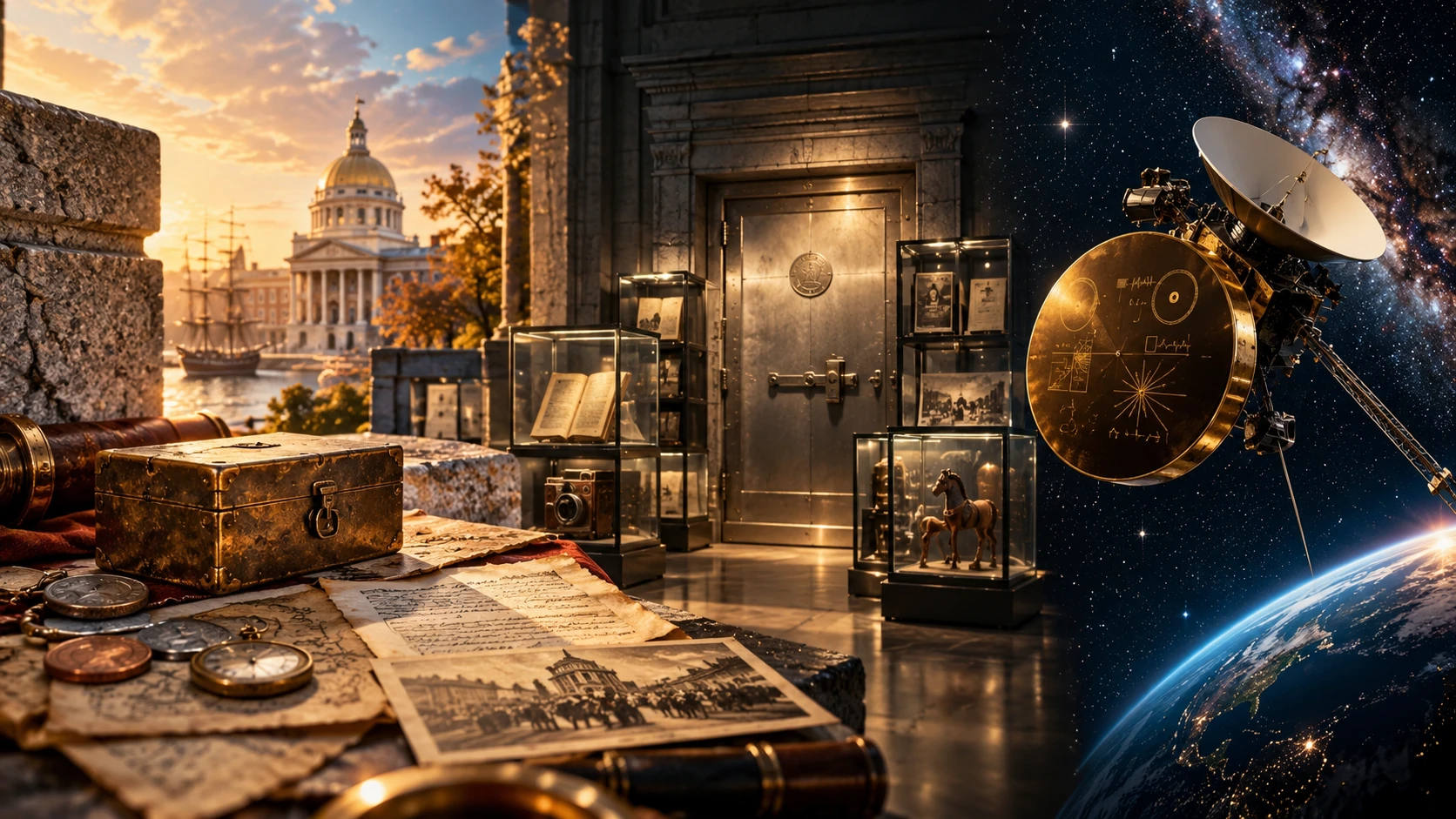
The opening paragraphs are an imagined picture, not a description of a specific event. Every historical fact later in the article is supported by the sources listed at the end.
A letter addressed to those not yet born
Imagine an old house.
Outside its windows the seasons change. Cars appear on the streets. People change their clothes, their language, their habits. Children are born, grow up and raise children of their own.
And somewhere inside the house lies a small metal box.
Nobody calls it. Nobody checks whether the message has arrived. It simply waits.
Decades pass. Then centuries.
And one day people open the box and suddenly find themselves sharing a space with those who have long since left the world of the living.
This is not science fiction. For centuries, this is how humanity has tried to cross the most relentless distance of all — time.
We are used to messages that travel through space: from city to city, country to country, from one phone to another in a fraction of a second. But there is another kind of journey — slow, quiet and far braver. These are messages sent not "there" but "then". Their authors know they will never see them read. And they write anyway.
Here are four true stories of words that learned to wait.
Boston, 1795: a message that outlived two centuries
On 4 July 1795, as the young American republic marked its nineteenth birthday, the cornerstone of the new Massachusetts State House was laid on Beacon Hill in Boston. Beneath the stone went a small deposit — what today we would call a time capsule. The ceremony involved Governor Samuel Adams, the silversmith and revolutionary hero Paul Revere, and William Scollay.
What could they have placed inside? Not treasure, and not prophecies. Coins. Newspapers. A medal bearing the image of George Washington. A silver plate. The ordinary things of their day — things people used, read and carried in their pockets.
Sixty years went by. In 1855, during repairs to the building, the deposit was found and opened. The Bostonians of that time examined the contents, added items of their own and laid it beneath the stone once more. A message that had already outlived one generation was given a second life — and new co-authors.
Then it was forgotten again. Until December 2014, when work on the foundations to fix a water leak brought the capsule to light for a second time. On 6 January 2015, specialists at the Museum of Fine Arts, Boston, carefully opened it.
Let us imagine that moment. Cold metal that has to be opened slowly so that nothing is damaged. The faint rustle of old paper. Coins darkened by time. Newspaper pages carrying news that has not been news for more than two hundred years. A medal that may once have been held by people who knew Washington personally.
And then a strange transformation takes place. An ordinary coin that once would have bought bread becomes historical evidence. A newspaper read over breakfast and forgotten becomes a window into the past. Objects that meant little to their owners gain value precisely because they have passed through time.
What moves us most is this: the people of 1795 could not know what world awaited their message. They could not imagine electricity or cars, or that their capsule would be opened by gloved hands in front of cameras, with photos travelling around the globe within minutes. They simply believed the future would come — and that someone in it would want to know who they had been.
The Crypt of Civilization: a room not to be opened until 8113
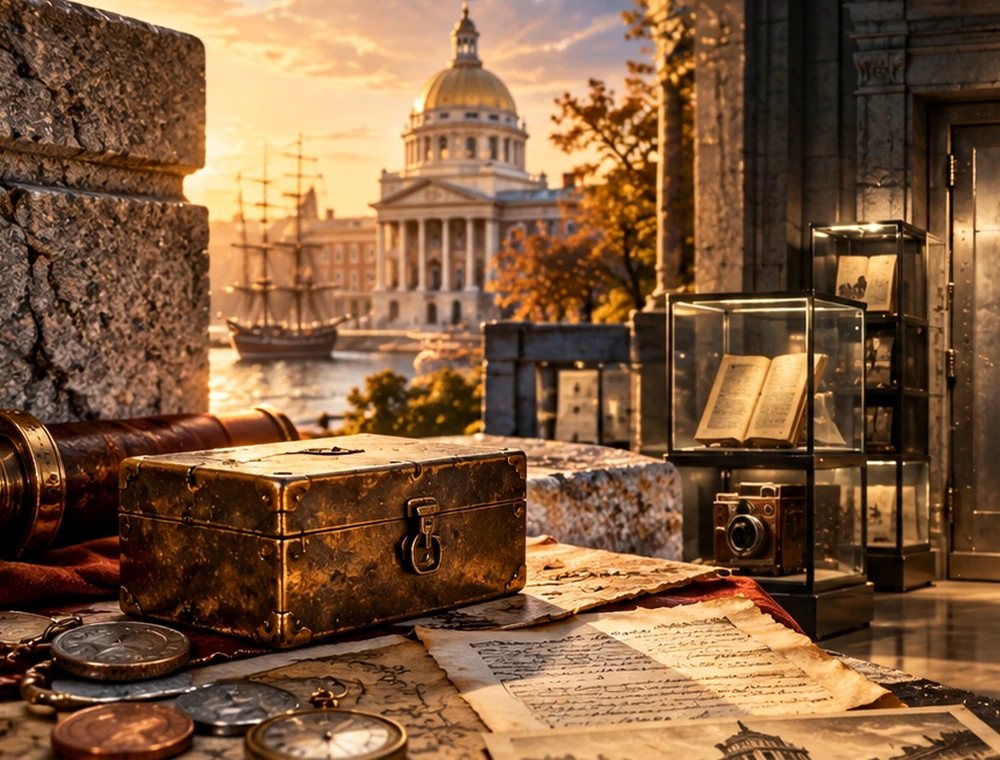
Let us travel to Atlanta, Georgia, to the campus of Oglethorpe University. In the 1930s the university's president, Thornwell Jacobs, conceived a message on a scale that is hard to grasp: not a hundred years ahead, not a thousand, but more than six thousand.
Studying ancient history, Jacobs was struck by how little we know about the daily life of ancient civilisations. So he decided to do for distant descendants what the ancients had not done for us: leave a deliberate, organised archive of his own time. The result was the Crypt of Civilization — a sealed room filled with objects and materials documenting life in the twentieth century: recordings, books on microfilm, everyday items, the sounds and images of an era.
The crypt was officially sealed on 28 May 1940. Its planned opening date is 28 May 8113.
Picture that door. Steel with silence behind it. No one will go in to check that all is well. None of those who watched it close will ever learn whether it is opened. A door designed not for visitors, but for an age.
And the questions that follow are almost dizzying. What will human civilisation be like in six thousand years? Will the people of the future understand our language? Will they be able to imagine how we lived, what we feared and what we dreamed of?
No one can guarantee that the crypt will actually be opened on that day: 8113 is a planned date, a promise rather than a timetable. But perhaps that is the strength of the idea. Jacobs could not control the future. He could only make sure our descendants would have something to find.
Voyager, 1977: the voice of Earth travelling between the stars
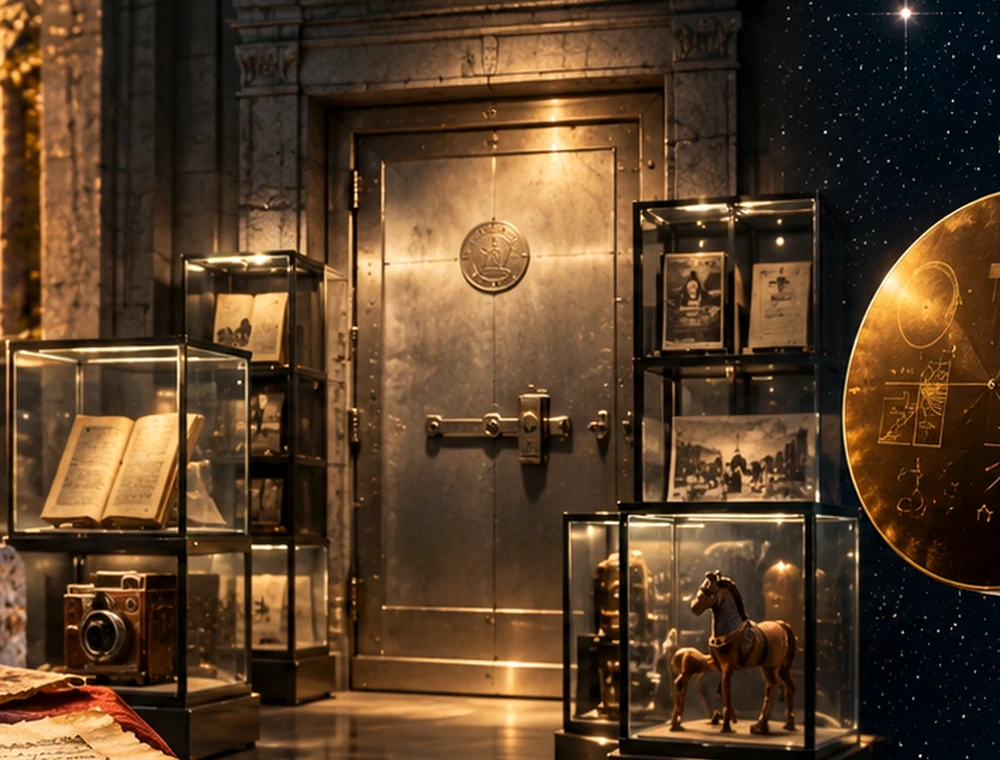
In 1977 NASA launched two spacecraft — Voyager 1 and Voyager 2. Their task was to explore the distant planets of the Solar System. But each carried a cargo that had nothing to do with science in the usual sense: the Golden Record, a gold-plated disc bearing a message about Earth.
The contents were chosen by a committee chaired by the astronomer Carl Sagan. The record holds 115 images telling the story of our planet, its people and their lives. The natural sounds of Earth: wind, thunder, surf, birdsong. Greetings in 55 languages. Music from different cultures and eras. Diagrams engraved on its cover are meant to explain how the record can be played.
Humanity has learned to send spacecraft beyond the orbits of the planets. Yet the most moving cargo on board may not be the scientific instruments, but human voices, the sound of rain and the music of our small planet.
The honest answer to the central question is simple and piercing: no one knows whether anyone will ever find these messages. Space is vast, and the spacecraft are tiny. The records may drift for millions of years without ever being heard.
So why did people send them? Because a message to the future is not only a bet on a reply. It is a way of saying: "We were here. This is what we loved. This is how our world sounded." People left words for those they may never meet — and there is more hope in that gesture than in any guarantee.
Norway, 2014–2114: a library whose books will be read in a hundred years
The gentlest of these stories begins not with metal or steel, but with trees.
In 2014 the Scottish artist Katie Paterson launched an art project called Future Library. A thousand trees were planted in a forest near Oslo. Each year one writer contributes a new work that remains unpublished: no critic, no reader, not even the author's family will read it. The manuscripts are kept in a special room in a library in Oslo. And in 2114, when the trees have grown, there are plans to make paper from them and print all the collected texts.
The first author was Margaret Atwood. She wrote a text she herself will never see in print — and handed it to readers who have not yet been born.
Imagine the silence of that room. Manuscripts no one opens. And a few kilometres away, a forest where the trees grow slowly, year after year, ring after ring, as if counting down to the day they become pages. Somewhere in the future lives a child who, many years from now, will hold one of these books. That child's parents have not yet met.
This is not just a library. It is an act of faith in future generations: faith that in a hundred years people will still read, still want to hear stories, and still take care of a forest in order to receive them.
From stone to digital memory
Let us look at these stories together. To preserve a message for centuries, people once needed stone buildings, cornerstones, metal capsules, special archives, space agencies or forests. These were projects of governments, universities and artists.
Today everything has changed. An ordinary person can create a message in minutes: record a video on a phone, add photos, a voice message or a personal letter. What once required stone and ceremony now fits in a pocket.
But it is worth being honest about three different things:
- Creating the message. This is the easy part: record, write, take a photo.
- Reliable long-term preservation. The files have to survive changes of devices, formats and services.
- Delivery to the right person in the future. The message has to find its recipient exactly when the time comes.
The first is within everyone's reach today. The second and third need the support of a system, up-to-date contact details and responsible data management. Digital memory is not eternal on its own: it needs looking after, just like a paper archive. No one can honestly promise an absolute guarantee that a file will exist or be delivered in 50 or 100 years — but the odds can be improved significantly. We covered practical steps in A digital legacy plan in one evening.
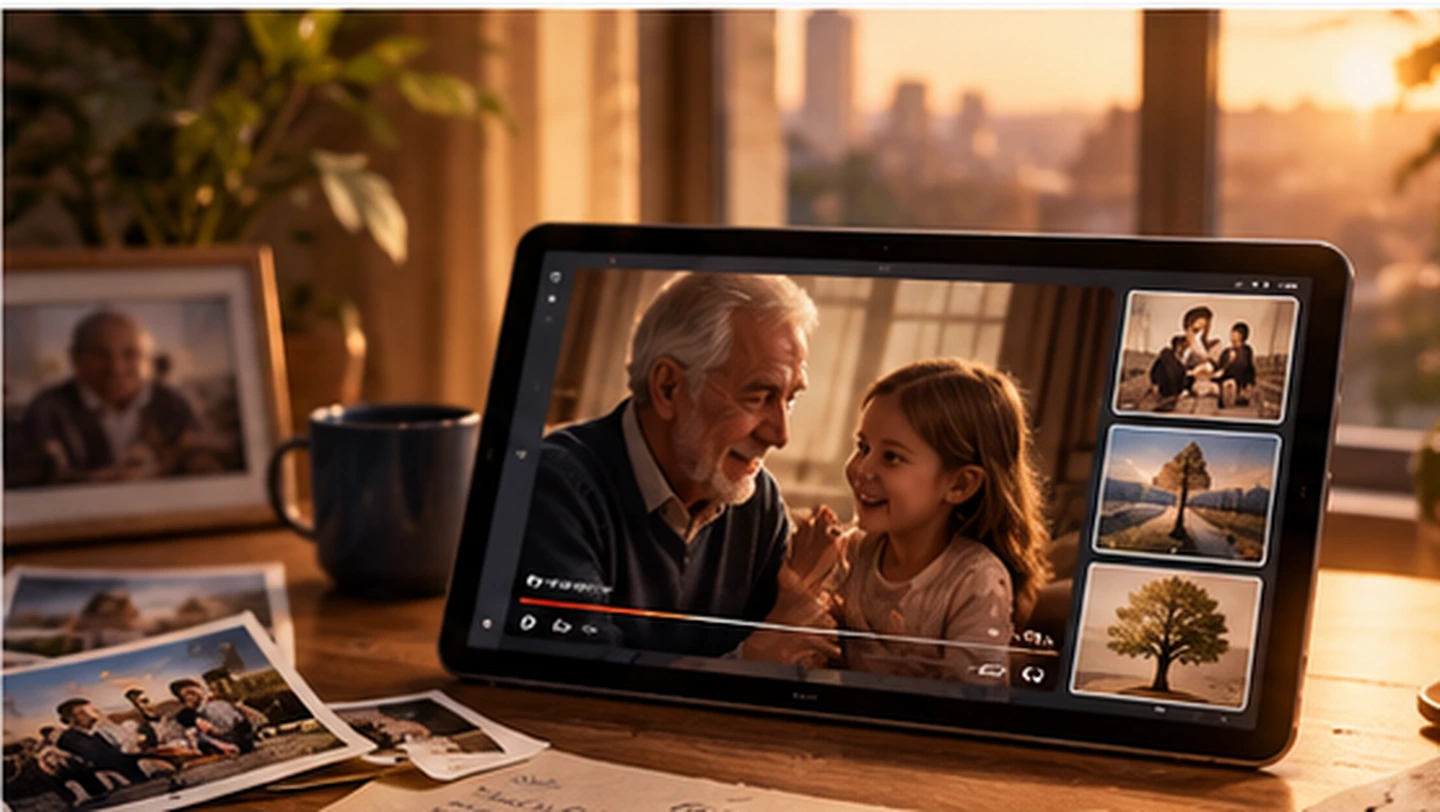
The most important message may be addressed to one person
NASA created a message for unknown civilisations. In Norway, a forest is growing for future readers. But for an ordinary person, the most important time capsule can sometimes be a two-minute video recorded for their own child.
That thought is where AEEVOX came from — a digital home for family memory. It is a place to gather what is usually scattered across phones, clouds and boxes in the attic:
- photos — together with the stories of the people in them;
- video messages — for a birthday, a wedding or a coming of age;
- voice recordings — a lullaby, a greeting, a laugh;
- personal letters;
- family documents;
- family stories that used to be passed on only by word of mouth;
- a family tree where every memory has its place;
- messages meant for future dates.
A time capsule in AEEVOX can be prepared for a specific day: you choose the recipient and the date, and the message waits for its moment. We explained how to write such a letter in How to write your first time capsule letter, and how a video message can wait twenty years in A Message That Arrives in 10, 20 or 50 Years.
The hardest part of any message to the future is not keeping it, but finding the person. Over the years a recipient may move to another country, change their surname, email address or phone number. That is why in AEEVOX a recipient's contact details can be updated and trusted people can be named, so that someone who knows the family can help the message arrive. Automatic AI-powered recipient search and physical delivery of letters or storage media do not work at present — they are only ideas for the future, and we do not present them as existing features. The most reliable plan today is to combine a digital capsule, a paper letter in the family archive and a trusted person who knows about both.
Words that will wait
Perhaps your message will never fly to the stars.
Perhaps it will not be kept for six thousand years.
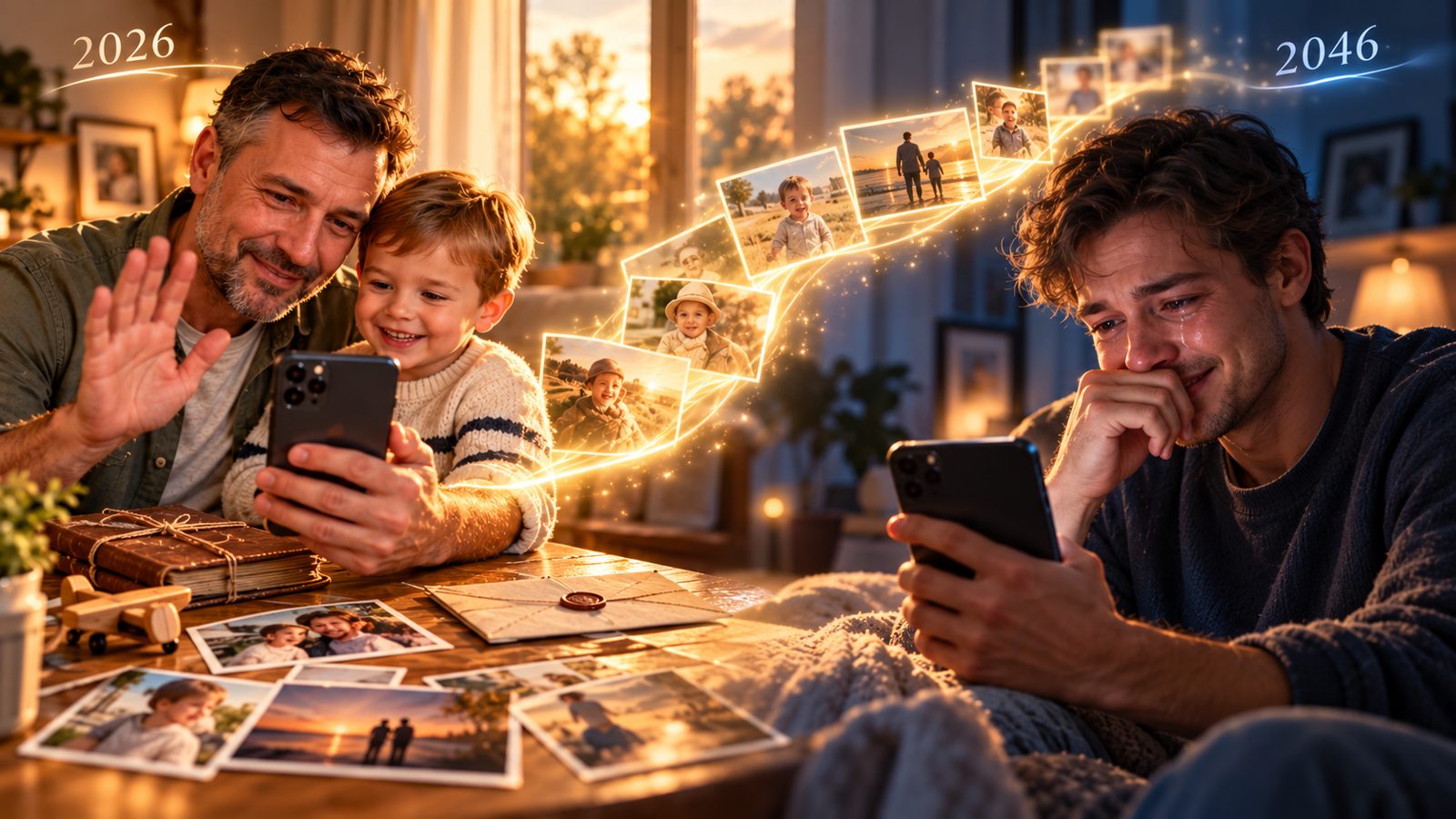
But if, twenty years from now, your child opens a message, hears your voice and smiles through tears — isn't that one of the most important journeys human words can make?
We cannot stop time.
But we can leave in it what we do not want to lose.
AEEVOX — a digital home for family memory.
If there are words that should wait for their day, start small. Create your first time capsule in AEEVOX — a few sentences, one photo or a short video can already become a message to the future.
Sources
- Museum of Fine Arts, Boston — Time Capsule (conservation)
- Museum of Fine Arts, Boston — Inside the Box: Massachusetts State House Time Capsule
- Oglethorpe University — Crypt of Civilization
- NASA — Golden Record Contents
- NASA — Voyager Golden Record Overview
- Katie Paterson — Future Library
- Future Library (Framtidsbiblioteket), Oslo
All images in this article are artistic illustrations, not historical photographs.